

Disclaimer: The purpose of this blog (now Substack) is not to expose readers to the nonsense and dysfunction of the world, but to correct the damage it causes. If you do not know what IFS is, stop reading now. There is no benefit to being introduced to retardation you have not yet been subjected to. So seriously, stop now, this piece is not for you.
However, if you have encountered IFS, or G-d forbid met one of its MLM practitioners, this piece is tailored to deprogram you. Since Richard Schwartz’s mind is allegedly composed of “parts,” we will honor that framing and break this critique into parts as well.
“Don’t believe everything you think.”
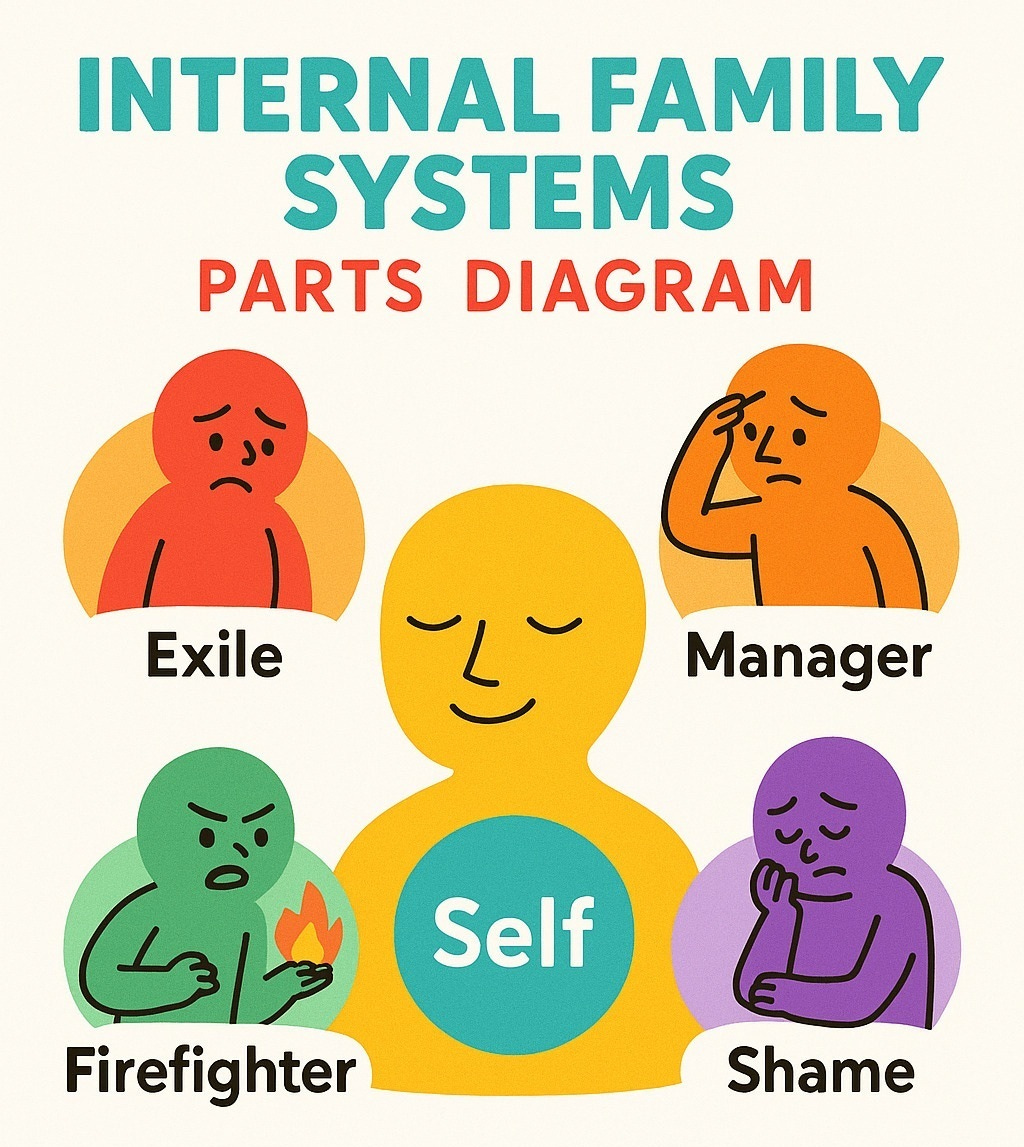
Part I: Genesis of a Delusion
So, it has come to my attention that there is this type of “therapy” called IFS, which stands for Internal Family Systems. Being an optimist (in general) against my better judgment in this case, I briefly wondered if maybe this was actually something useful and not just another method (read: scam) to separate vulnerable people from their hard-earned money. So I investigated. What I found was a system built around the idea that your mind is not a mind at all, but rather a diverse cast of characters all chattering around in your head, and that this is not only not concerning, it is perfectly normal.
Imagine my shock when I learned that the creator of IFS, Richard Schwartz, designed a framework that reads like it is attempting to treat Multiple Personality Disorder. It is coded like someone who interprets every flicker of internal experience as a separate person, then exports whatever psychological issues he suffers from to everyone else. Instead of concluding “maybe I should get a grip and be on some meds,” he concluded “everyone else must also have twelve different personalities fighting over the controls,” handed his intrusive thoughts a microphone, and built an entire therapy empire (MLM) around letting them debate each other. Schwartz did not just share his internal chaos, he systematized it. He turned his inner noise into a curriculum. That curriculum is not scientific, nor clinical, and certainly not evidence-based; it is metaphysics dressed in drag, sold as therapy.
“Modern people, especially urban people, think that anything which has got itself printed has somehow passed an examination and received a diploma; has somehow, in fact, shown itself to be true.” - G. K. Chesterton
The entire framework reads like it was built by someone who spent a lifetime suffering from all the various voices in his own head and decided the rest of us should join him in the chaos. And instead of putting a stop to it, and getting this man a padded room with 24/7 supervision, the academic world handed him a Ph.D. Publicly peddling emotional fragmentation as therapy is not enlightened; it is predatory. By redefining thoughts as “entities,” IFS dodges accountability and floods people with identities they never needed. Treating psychological splintering as normal is not compassion; it would be malpractice if the system did not so carefully avoid making clinical claims.
And keep in mind, this is just the premise, the tame part. I have not even begun addressing how Schwartz claims he discovered this system, which on its own should shut down the entire charade. Just wait until you hear where he got it from!
Part II: Revelation According to Richard
So one day, Richard was bored and decided to dialogue with one of the voices in his head that he treated as independent beings. He spoke to a part and was surprised when it answered him. From this, he concluded that these parts had different ages, fears, objectives, roles, and voices, which he proudly describes as having “full personalities.” There is a diagnosis for having multiple full personalities living inside your mind, but Richard somehow managed to reinvent it as a spreadable disease.
It was not only his own inner cast that he treated as real. While working with distressed clients, including eating-disorder patients describing urges, compulsions, intrusive thoughts, and inner conflict, he interpreted their language literally. Instead of considering that trauma, anxiety, self-criticism, and dysregulation can feel like internal conflict, he declared these experiences to be evidence of multiple beings. Their metaphors became data, their symptoms became a cosmology, their private suffering became confirmation of his personal worldview. At no point did he apply any empirical method, testing, or falsification. He did not ask whether these experiences had neurological, cognitive, or psychological explanations. He simply took subjective experience as objective reality and built a system around it.
Richard then layered revelation-coded spiritual language onto the entire process. He described these parts as “sacred,” spoke about them being “revealed” to him, and framed the Self as a “divine essence.” He introduced ritual unburdening ceremonies in which these parts are instructed to release their pains into imaginary fire, water, wind, or some glowing internal light. This is not therapy; it is a pagan ritual dressed up in clinical language and sold as intervention.
“Dumb people use spirituality to give themselves dimension.”
Since he never questioned any of this, Richard concluded that these parts were not unique to him or to his vulnerable clients. He declared that all humans are born with a full cast of personalities, and he ‘verified’ it the same way he discovered it, simply by asserting it. Anything that aligned with his worldview was treated as revelation. Anything that challenged it was reframed as another protector part. The model is a perfectly constructed unfalsifiable catch-22; it cannot be wrong because any disagreement becomes further proof.
What is surprising is not that Richard believed all of this as there are plenty of loonies in the world with mental disorders. What is surprising is that well-adjusted adults institutionalized his delusions instead of institutionalizing Richard. He built a faux-therapeutic system out of conversations with imaginary entities inside his own head, chose to treat them as separate beings who spoke to him, and then universalized that private phenomenology into a global psychological doctrine. Instead of professionals saying, “Richard, this is not how evidence works,” the mental health field absorbed his revelations without demanding any testing, falsification, or proof. When someone builds a clinical modality out of internal dialogues and LARPing fantasy rituals, the appropriate response is not institutional praise. It is collective embarrassment that this was ever taken seriously. Now that the origin story is out of the way, the real disaster is what IFS actually does to people. This is where theory turns into damage.
Part III: The Fracturing of the Self
Sometimes feelings are just feelings. Sometimes they matter, and sometimes they are your brain firing off nonsense. IFS cannot tolerate that distinction. Instead, it creates a paradigm where every spike of anxiety, shame, or stupidity is sacred that must be analyzed as if it carries divine revelation. The more attention and legitimacy you shovel onto your retarded feelings, the more they metastasize, and the more dependent you become on your feelings shaman to interpret them.
Internal conflict is real, thus people experience ambivalence, fear, shame, and self-criticism. Talking about feelings can help, and metaphors can help, and none of that is controversial. The problem is that IFS does not use metaphor to clarify experience, it literalizes metaphor. What begins as a way of speaking about the mind becomes an invented and false doctrine about what the mind actually is. At that point, the damage gets baked in.
IFS asserts that everyone has literal internal sub-personalities. CBT, a legitimate therapeutic approach, treats intrusive thoughts as meaningless static and teaches you not to give garbage oxygen. IFS teaches you the opposite, it tells you that every impulse must be elevated, explored, and given emotional importance. CBT builds resilience by starving intrusive thoughts. IFS builds obsession by feeding them until the noise becomes your identity. The more attention you give intrusive thoughts, the more your brain generates them.
“There is no reality except action.” - Jean-Paul Sartre
Once you treat intrusive thoughts as characters, IFS instructs you to deepen them. You ask what age the thought is, what it wants, what it fears, and what trauma it carries. You rehearse every shame flicker and every intrusive thought until it becomes a permanent fixture in your mind. You turn random cognitive garbage into a full-blown emotional narrative. IFS takes a flicker of mental nonsense and forces you to invent an entire origin story to please your feelings shaman. This does not heal intrusive thoughts, rather it cements them.
IFS rewires people to see every impulsive spark as an individual character who deserves attention. It trains fixation and encourages rumination. It multiplies intrusive thoughts by solidifying them and teaches people to negotiate with their mental trash instead of discarding it. And once impulses are treated as meaningful messages, the next logical step is inevitable: they need messengers, roles, and identities.
IFS teaches people to leave the driver’s seat of their lives so they can conduct interviews with the gremlins they believe are living in the attic. You are instructed to step aside so your “protector” can take control, or so your “exile” can speak. This is not healing, this is fragmentation as a lifestyle. It teaches people to inhabit themselves less, not more, and then applauds them for becoming passive spectators in their own minds.
People in IFS frequently report feeling floaty, hollow, disconnected, blurry, and less embodied. This is not accidental, as the language is designed to anesthetize alarm bells. “Unblending,” “Self energy,” and “curiosity” are linguistic chloroform, terms chosen to make dissociation feel virtuous instead of dangerous. Any normal therapist would recognize this as classic dissociation, yet IFS reframes it as “accessing Self energy.” That is the spiritual-coded scam at the center of this entire ideology. Instead of saying, “You are dissociating; let’s bring you back into your body,” IFS tells you that this numb, distant, out-of-body sensation is actually proof you have reached some higher plane of consciousness. Trauma responses become divine revelation while emotional absence becomes enlightenment.
And once dissociation is rebranded as spiritual achievement, you can keep people in therapy forever. Because the less present, grounded, and embodied they feel, the more “Self energy” they think they’re accessing, and the more they rely on their feelings shaman to guide them through their own mentally induced fog. IFS rewards the exact psychological patterns that disable clarity, agency, and decision-making. The fact that this is sold as healing should disturb anyone with half a functioning brain cell.
Part IV: The Unfalsifiable Idol
From the moment an IFS session begins, you are instructed to identify which “part” of you is present, how old this part is, what it fears, what it wants, and what it is supposedly protecting you from. You are treated as if you are hosting a full internal cast of competing personalities, exactly the way Schwartz describes his own mind. And, conveniently, none of this crap can ever be tested or disproven. Every objection is a protector, every counterargument is a manager, and every moment of doubt is just another part acting up. The whole modality is hermetically sealed from reality by design. Academic language gives the system just enough legitimacy to disguise what is, functionally, a closed belief loop.
This is the “logic” of a self-sealing belief system. Agreement confirms the model while disagreement becomes a protector. Doubt is reframed as a manager, improvement is resistance, and wanting to leave is avoidance. Every possible response is interpreted as further proof that the system is correct. There is no external reference point, no neutral ground, and no way to falsify the claims because every objection is absorbed as content. That is not a clinical framework; it is cult logic with better branding.
“Evil always takes advantage of ambiguity.” - G. K. Chesterton
Part V: The Endless Wilderness
IFS does not heal; it metastasizes. It trains people to multiply their problems indefinitely and rewards emotional fragmentation, while stability gets reframed as avoidance. The system is designed to create more insecurity in your mind, not less, because insecurity is the fuel. Instead of encouraging you to accomplish anything in your actual life, you are trained on endless introspection and instructed to obsess over your feelings like they are holy scripture. If you focused on improving your life, you might actually get better, and then you would not need your weekly Hajjaj to a feelings shaman to decode the nonsensical brain static they implanted in you. In IFS, the only way to “heal” is to discover more personalities in your head, which by cosmic coincidence requires more sessions, more hours, more workshops, and more money. The client becomes the content generator, the therapist becomes the interpreter, and your “healing journey” becomes a lifetime subscription to the mythology. IFS is not therapy, it is an infinite content farm disguised as introspection, a psychological pyramid scheme where your symptoms are their revenue and your progress is their loss.
Here is the part that exposes the scam perfectly: in IFS, nothing is ever resolved. No part ever finishes its job, no emotion ever dissolves, and no symptom ever leaves. If you feel better, you are told parts have “gone into hiding.” If you stop producing material, you are accused of “blending.” If you stop needing sessions, your protectors are suddenly blocking access to deeper wounds. Recovery is reframed as resistance, stability is treated as pathology, and improvement itself is reclassified as a diagnostic failure. And this is not a bug, it is the design. IFS has no discharge criteria, no measurable outcomes, and no definition of success, which means it cannot fail and therefore cannot end.
Once that trap is set, the architecture reveals itself. Every part has protectors, those protectors have protectors, those protectors have managers, and those managers have legacies. It is parts protecting parts protecting parts, the emotional equivalent of a multi-level marketing downline. But instead of selling life insurance, your therapist is selling you new personalities. The more parts you discover, the deeper the “healing.” The deeper the healing, the more sessions required. Infinite ambiguity transforms into infinite billing.
Once the system is in place, the mythology has to expand and IFS escalates your inner world into a full sacred text. Therapists encourage clients to identify ancestral trauma parts, cultural exile parts, society burden parts, and my personal favorite, Earth protecting parts. Yes, the planet itself now gets a psychic security guard assigned to you. At this point there is no endpoint, every session becomes an opportunity to inflate your personal cosmology. There is never closure, never resolution, never integration, only an ever-expanding cast of characters auditioning for roles in the ongoing soap opera that is now your mental “health.”
IFS is not just therapeutic nonsense, it is structurally identical to a multi-level marketing scheme. The product is not healing, rather it is discovery. Every new “part” you uncover justifies the existence of more parts beneath it. Protectors protect exiles, managers manage protectors, legacies burden managers, and ancestral ghosts supervise the whole operation. There is no terminal diagnosis, no graduation, and no finish line. Like any MLM, the system only works if the downline never ends. The moment you stop producing material, you are declared blocked, blended, or resistant. Progress becomes failure, stability becomes sabotage, and the only success state is infinite internal complexity, which conveniently requires infinite sessions.
And just like any real MLM, the internal downline is mirrored by an external one. Clients become trainees, trainees become facilitators, facilitators recruit new facilitators, and everyone pays for certifications, workshops, retreats, and levels. The ideology spreads not through results, but through credential inflation and mutual emotional codependence. Your psyche becomes the content farm, and your therapist becomes the distributor.
Part VI: The Corruption of the People
IFS does not treat adults as adults, it treats them as permanent toddlers managing a daycare inside their skull. Every discomfort is reframed as a frightened child, and every responsibility becomes a threat to safety. The normal demands of adulthood are treated as violence against some wounded inner minor. There is no expectation of endurance, maturity, or emotional sovereignty. You are trained to soothe yourself endlessly instead of strengthening yourself. This is not compassion; it is psychological regression marketed as kindness, and it pairs perfectly with a culture already addicted to victimhood. IFS is the perfect therapeutic ideology for a culture that confuses fragility with virtue and calls regression “inner-work.”
“Most people don’t want freedom. They want comfort, safety, and someone to blame.”
Over time, IFS erodes the most basic requirement of mental health: a continuous sense of self. Healthy people experience themselves as a single agent across time who makes mistakes and owns them. IFS trains people to disown their own actions. It was not me, it was a part. It was not my choice, it was a protector. It was not my failure, it was an exile acting out. This sounds compassionate until you realize it destroys accountability entirely. Character cannot be built if nothing is ever yours. Responsibility dissolves into subpersonalities, and adulthood is replaced with endless internal arbitration. Once bad behavior can be outsourced to a part, the system becomes a moral laundering machine for anyone who wants absolution without change.
IFS did not spread because it works, it spread because it is perfect for incompetent therapists. It requires no insight, no confrontation, no risk, and no responsibility for results. The practitioner never has to be correct, only curious. They never challenge, they “witness.” They never give direction, they “hold space.” IFS turns therapy into guided journaling with a license and a billing code. It flatters the therapist’s sense of depth while absolving them of competence. The result is not healing, but a generation of adults quite fluent in trauma language and equally allergic to adulthood.
Part VII: The Idol Complete
After enough time in IFS, the client becomes psychologically articulate and functionally inert. They can narrate every feeling but cannot execute a plan, describe trauma or tolerate discomfort. They are hyper-aware, hyper-verbal, and paralyzed in stagnation. Decision-making feels dangerous because every choice might anger a part. Strength feels suspicious and clarity feels aggressive. What emerges is not a healed person, but a museum curator of their own neuroses.
At this point, the whole thing stops pretending to be psychology and becomes improv theater. You are no longer a person with problems; you are hosting a full quorum meeting inside your skull. Your anxiety has a job title, your sadness has a backstory, your anger is a firefighter with trust issues. Everyone is negotiating, nobody is driving, and the therapist nods along like the Dungeon Master of your emotional DnD campaign.
IFS is not misunderstood, misapplied, or ahead of its time, in fact it is functioning exactly as designed. It fragments identity, rewards dissociation, infantilizes adults, and guarantees dependency. Its brilliance is not therapeutic; it is architectural. It cannot fail, it cannot resolve, and it cannot let you leave. That is not a therapy model; that is a psychological pyramid scheme with an annoyingly soft voice and a clipboard.
Final Part: Judgment
IFS is a business model built out of an unfalsifiable inner cosplay, which works best when you never get better.