

Every shul has a self-appointed Minister of Silence. The moment you read that sentence, someone popped into your head. Yup, that guy. Generally, he is a miserable person with no life and no joy who, like a schoolyard bully, seeks to make everyone as miserable and lifeless as he is. It’s not noise so much as it is happiness, which he easily detects and more quickly rushes to quash.
Well, the position of Minister of Silence is not limited to the Jewish religion and apparently churches have them as well. So much so that it became a culture war debate on social media. The main characters are Matt Walsh and David French, who decided to go at it on social media (again lol) on this precise topic. This time it was over a church deciding to make a “Loud Kid Policy” which can be read below:
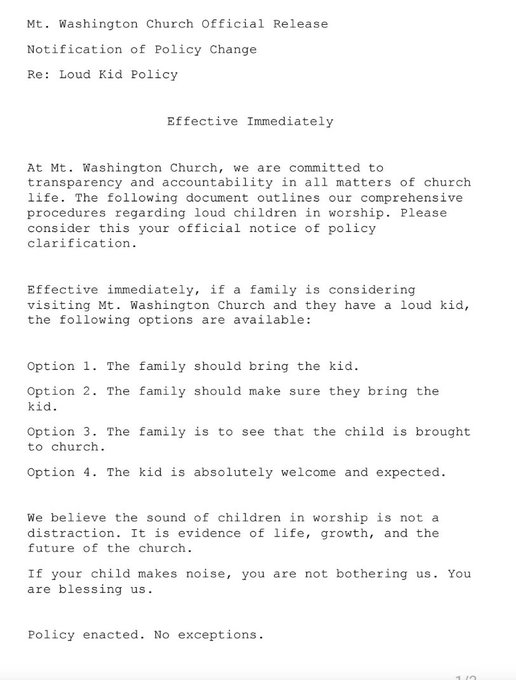
For the uninitiated, Matt Walsh is a very order-focused conservative commentator. David French is a hicklib. But that’s not super important for the purposes of this article, just some interesting background on our dueling personalities. Well, Matt responded to the “Loud Kid Policy” as follows:
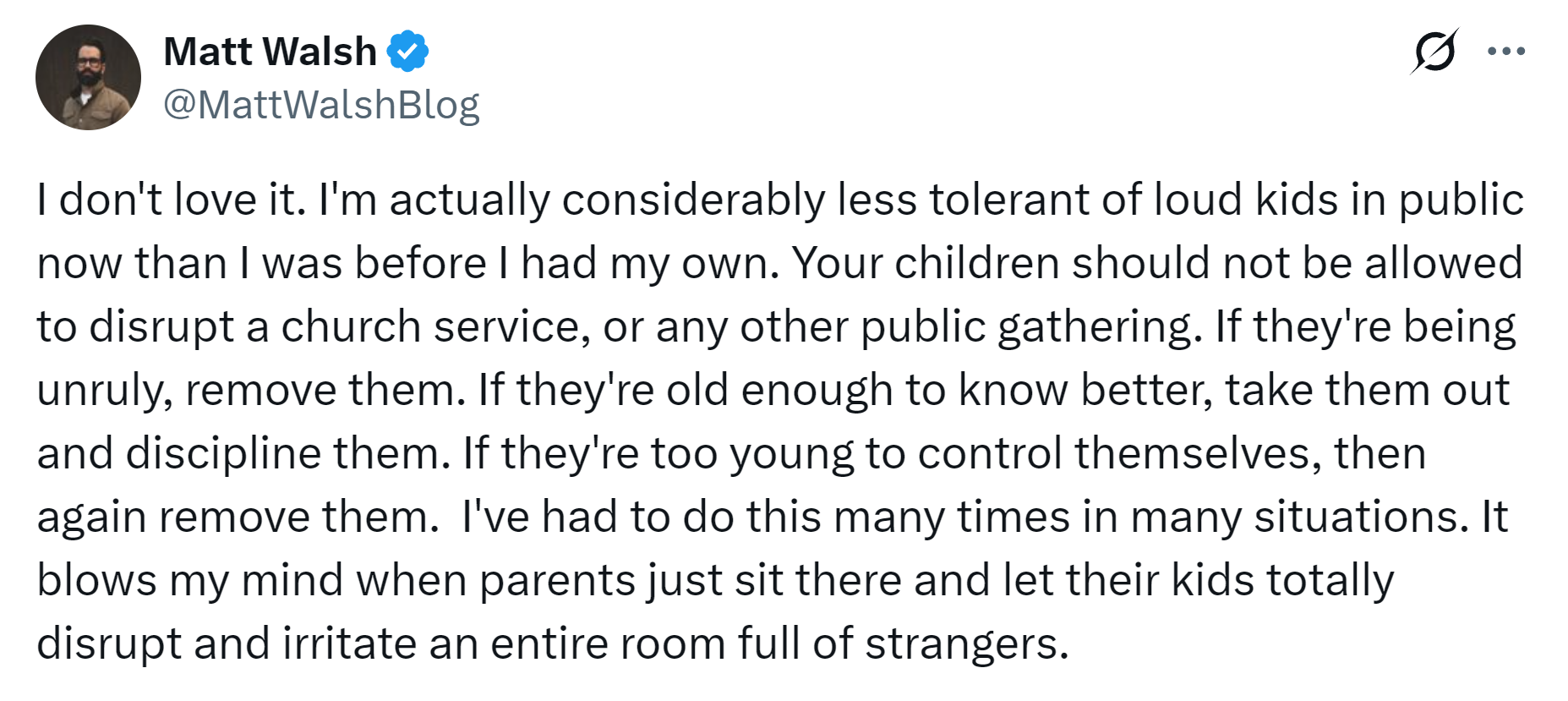
So, the obvious question is, what is the policy we should take as a community towards raising our children correctly? The Minister of Silence angrily reading my article is probably excitedly running over to his shelf to flip through the Mishnah Berurah as fast as his stubby legs can carry him. And to be fair, things over there are actually pretty clear-cut. he Mishnah Berurah (Orach Chaim 98) notes that small children who disturb the congregation during prayer should not be brought to shul. Seems cut and dry on the side of Team Walsh.
Well, Lubavitch is different! Enter the Rebbe in 770 on Purim 1981, when the kids went crazy with overenthusiastic noisemaking during the Megillah reading. Obviously we all understand the importance of hearing every word of the Megillah, so many of the (grumpier) adults present attempted to quiet down the kids. In the moment, the Rebbe smiled broadly at the noise-making of the children. Later, the Rebbe said directly to those adults:
“In their innocence, the children were enjoying the spirit of Purim. Of course you want to hear the reading, but we must also appreciate G‑d’s own great joy in seeing these children celebrate.”
The Rebbe wasn’t done. At a farbrengen that Shabbos, the Rebbe commented further.
“The gabbaim walk around with serious faces, attempting to shorten the noise-making, but the children know that there is still a Haman!”
Another incident with the Rebbe involving unsupervised kids occurred on Shavuos in 1978. A young child in 770 mistook the Rebbe for his father, grabbed his hand, and wiped his dirty face on the Rebbe’s coat. The mother was mortified and wrote an apology letter to the Rebbe. The Rebbe responded to her letter:
“On the contrary: He brought me great pleasure. One cannot begin to measure the heartfulness, simplicity, innocence, and sincerity of a child, if only similar qualities could be found in adults.”
Strange that he didn’t respond with a lecture about maintaining an “orderly” shul and keeping “control” of her children.
The Rebbe wasn’t done there. In the spring of 1980, he launched a major campaign, Mivtza Aseres Hadibros, urging that every single Jewish child be brought to shul on the first day of Shavuos to hear the reading of the Ten Commandments. And yes, that explicitly included newborns and infants. Obviously all the male Karens who misunderstand the purpose of shul and instead view it as an ego validation exercise for themselves revolted. How are the adults supposed to concentrate, maintain decorum, and actually hear the Torah reading?
Good news is that the Rebbe didn’t leave us hanging for too long and responded to all of these concerns directly at the farbrengen on the Shabbos preceding Shavuos!
He pointed to the famous Midrash that before giving the Torah, Hashem demanded guarantors. The Jewish people suggested the patriarchs. Not good enough. The prophets. Rejected. Only when they said “our children will be our guarantors” did Hashem agree. Which means something very simple: the reason we have the Torah in the first place is because of the children. Complaining about their presence while reading it is missing the entire point.
Second, the Rebbe emphasized that Shavuos is not just a commemoration of Matan Torah. It is a re-enactment of it. At Har Sinai, every Jewish soul was present: men, women, children, and infants. If babies belonged at Mount Sinai, they belong in shul when the Ten Commandments are read.
The Rebbe rejected the argument that infants gain nothing from being there. Even if a child cannot intellectually understand the words, the holiness of the moment reaches the neshama. The spiritual impact of that experience outweighs an adult’s preference for perfect silence.
The Rebbe taught that the sounds of Jewish children in a shul should not be viewed as a nuisance. The crying or babbling of a child during the Ten Commandments is precious to G-d. If the noise makes it a bit harder for the adults to hear the reader, that is a sacrifice worth making so the children can be there.
To help manage the environment and ensure the kids didn’t feel like they were just being dragged to a boring, restrictive service, the Rebbe also encouraged communities to throw ice cream parties for the children immediately afterward. This ensured that their association with shul, the Torah, and the holiday would remain entirely sweet and joyful.
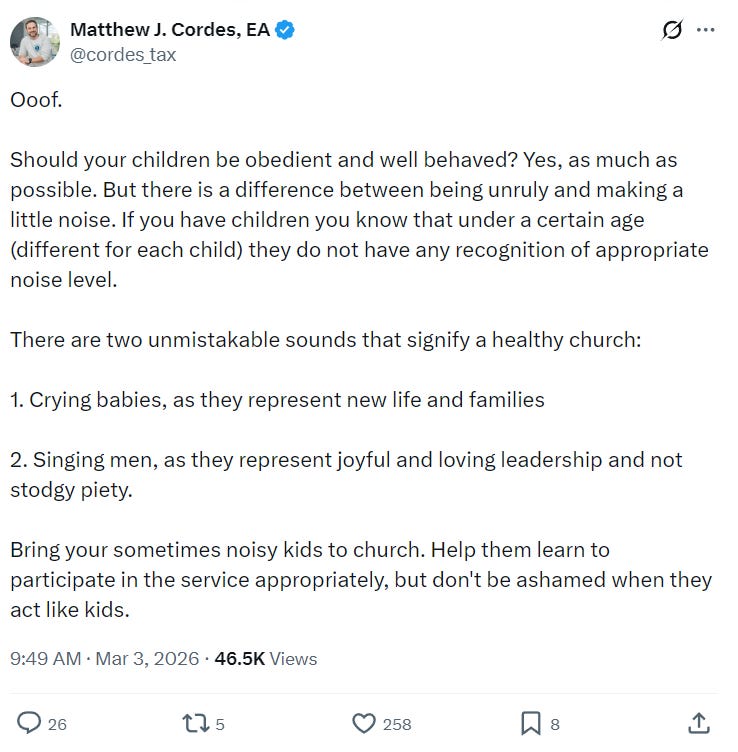
Matthew Cordes responded to Matt:
A shul should be a place where children feel welcome and free to be themselves. Creating this positive environment is the best way to make Yiddishkeit a source of happiness, ensuring they stay frum and continue attending shul into adulthood.
Obviously, if a child is having a full meltdown, it would be appropriate to step out with him for a bit. We are talking about behavior within the normal range of what kids do. This was never really about noise, and the entire Walsh/French debate misses the point. The question is not whether children occasionally make noise in a religious space. The question is whether adults remember why the space exists in the first place.
Many parents expend countless amounts of energy enforcing perfect discipline on their children. In the process, they squeeze the joy out of the mitzvah experience and turn their children into robots. Ask enough children of BT families how that project turned out. Not super swell.
The children are not disturbing the purpose of the shul. They are the purpose of the shul.
EDIT: if this is your messaging, you are definitely the Minister of Silence:

A special appreciation to Yisroel Weisberg for his contributions to this piece.