

Paul Ehrlich is dead YSVZ. On March 13, 2026, he finally died.
Most people reading this article will not recognize the name, but they will recognize the ideas. You have heard his theories parroted by brainless NPCs repeating slogans about “overpopulation” and “too many people on the planet.” Ehrlich was the modern father of that ideology. He was a Stanford professor, bestselling author, and government advisor. For decades he argued that the central problem facing humanity was not war, poverty, or disease.
The problem, according to Paul Ehrlich, was the existence of human beings.
“The first effect of not believing in G-d, is that you lose your common sense.” - G. K. Chesterton
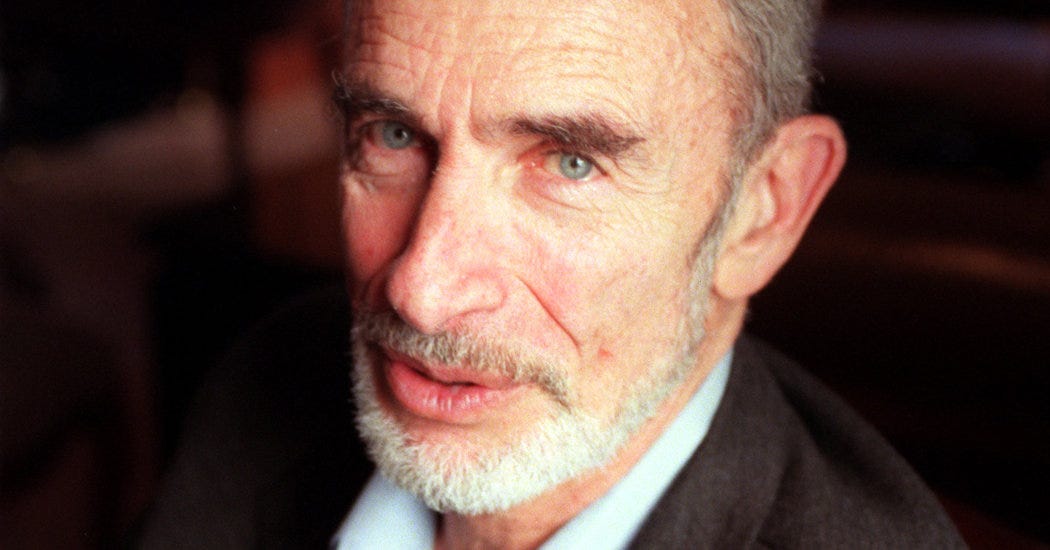
Many people come up with theories that are wrong, unfair, or just plain stupid. Very few manage to turn those stupid BS theories into a mainstream ideology embraced by millions. Paul Ehrlich was the exception; he built a mainstream human death cult. He believed that the existence of human beings was an evil that must be eradicated. Curing diseases was evil because it allowed more humans to survive. Having children was evil because somewhere there was a starving child in Africa. Human success itself became immoral. In Ehrlich’s worldview, it would be better if humanity simply starved and died.
I remember learning these nonsense theories in grade school, where we were taught (indoctrinated) about the looming catastrophe of “overpopulation.” At the time I didn’t really understand the arguments, but I definitely remember being worried about the coming ice age and the planet collapsing under the weight of too many humans. Fortunately, good ol’ Paul Ehrlich was here to save us from such a fate. His solution was simple: no more humans. No more babies being born, and the ones who were already here should start dying off as quickly as possible. Ironically, Ehrlich himself managed to live to 93.
“Public education has not produced an educated public.” - G. K. Chesterton

Dumb academics in ivory towers say stupid things all the time, but Paul Ehrlich managed to outdo them all. He predicted that hundreds of millions of people would starve in the 1970s and 1980s. Instead, the exact opposite happened. Food production increased and agricultural innovation exploded thanks to profit incentive. None of these weird imaginary fears about some sort of global famine in Ehrlich’s stupid head came to pass. Instead, more people than ever had access to food. Ehrlich was disappointed, because this wasn’t just a prediction for him, but a fantasy.
I know some of you think I’m being “extreme” or “overly judgmental” about this dead man. I’m not, he literally wrote entire fictional news stories about plagues killing millions of people. Some people write fantasy about wizards and dragons. Paul wrote fantasy about mass death.
Ehrlich repeatedly framed his teachings in one simple equation:
Population growth = cancer
And like any cancer, the solution was obvious: you don’t negotiate with it, you cut it out. Ironically, cancer is what eventually killed Ehrlich, not population growth. He pushed this idea relentlessly, framing human existence itself as a disease that needed to be eliminated. Ehrlich didn’t want there to be more abundance of food, better jobs or greater prosperity. He wanted us all dead.
When humanity cured malaria, yellow fever and other diseases, most normal humans celebrated. This was a win for everyone, we had actually achieved something. Though not for Paul and his evil cult of death. To him, saving lives only made the population problem worse. Every person who survived was another mouth to feed, another strain on the planet. What most people saw as progress, Ehrlich saw as a setback. Because if those people had died instead, the problem would have been smaller. In his world, dead would have been preferable to cured.
In his book, he points out that Costa Rica’s life expectancy was improving. You’d think that would be something that would make him happy. But no, Ehrlich teaches that people dying earlier is considered beneficial.
Ehrlich was unhappy that some countries had higher birthrates. To solve this, he proposed sending in helicopters and surgical teams to perform forced vasectomies on men with three or more children. Yes, he actually said this. And to preempt critics, Ehrlich wrote:
“Coercion? Perhaps, but coercion in a good cause.”
Thanos at least had the decency to leave half of the population alive. History usually remembers people who advocate mass suffering as monsters. Ehrlich is widely remembered as a distinguished professor.
“Wherever there is Animal Worship there is Human Sacrifice.” - G. K. Chesterton
The underlying theory of Ehrlich’s work was simple: everyone must suffer. Poor countries must stop reproducing. Rich countries must reduce consumption. Everyone must accept lower living standards. Ehrlich did not hate one group of humans more than another. He hated the existence of humanity. But his ideas didn’t die with him. He is the progenitor of the degrowth cult, anti-capitalist environmentalism, funded by people like Bill Gates and pushed by figures like Yuval Harari. The underlying theme is always the same: there are too many people.
In his book, Ehrlich includes an entire section on how to turn people against each other in the name of population control. If someone has eight kids, you’re supposed to guilt them about how they won’t be able to afford presents for all of them. If they are childless, you’re supposed to push them to resent those who have children. If they have two kids, you’re supposed to accuse them of selfishness. This is an instruction manual for recruiting others into his evil death cult. He even identified schoolteachers as ideal targets for spreading these ideas, arguing they were already primed to believe in overpopulation because of overcrowded classrooms.
“Modern people, especially urban people, think that anything which has got itself printed has somehow passed an examination and received a diploma; has somehow, in fact, shown itself to be true.” - G. K. Chesterton
The scary part is that Ehrlich was not some loser in his mom’s basement. He was a Stanford professor, a bestselling author, and a government advisor. He influenced millions and helped shape many of the ideologies that still plague our world today. He should have been on the edges of the fringes, but instead he was mainstreamed.
History has already answered Ehrlich, and his dumb predictions (fantasies) never came to pass. The mass famines he warned about never arrived. Instead, humanity became more prosperous than ever before. That should have discredited his ideas, but he built an unfalsifiable ideology. When things get better, it is just further evidence that the problem is getting worse. And when reality contradicts the theory, the theory stays (at least for the evil idiots still repeating it).
Ehrlich considered the distinct possibility that he may be entirely incorrect. To address this, he framed his solutions as a kind of no-lose situation. If he’s right, then extreme population control saves the world. And if he’s wrong, then fewer people is still a net good outcome. So either way, the answer is still the same. There was no point at which the problem was solved. Lower birth rates weren’t enough. Reduced consumption wasn’t enough. The people already born were still a burden. In his warped framework, even where you are born determines how much of a “problem” you are.
Paul Ehrlich spent his life insisting that humanity was a plague on the earth that needed to be eradicated. Thankfully, we largely ignored him and have flourished all the more for doing so. He spent his life trying to reduce the number of people on this planet. And now the man who warned that the world had too many people has finally reduced the population by one.