

Therapy is the most widespread trend of our generation. Every year another crop of professionally-useless people proudly announce that they’re “studying mental health,” which is code for “I didn’t want to learn anything useful or practical.” The core issue with therapy is that it is fundamentally the opposite of progress. Most people make dumb decisions in their own lives (except yours truly, obviously), and they need input from others to correct their crappy judgment. Apparently that is forbidden in therapy, since dispensing actionable advice would risk the client becoming functional, which seems to violate the sacred rules of the craft.
I know this sounds insane to the few of you intelligent enough to have avoided this scam, but it is literally against the rules of therapy for the therapist to give you good and obvious advice. You walk in wanting direction, but your therapist sits down ready to lob the same canned line, “Hmm. How does that make you feel,” with all the enthusiasm of a DMV employee.
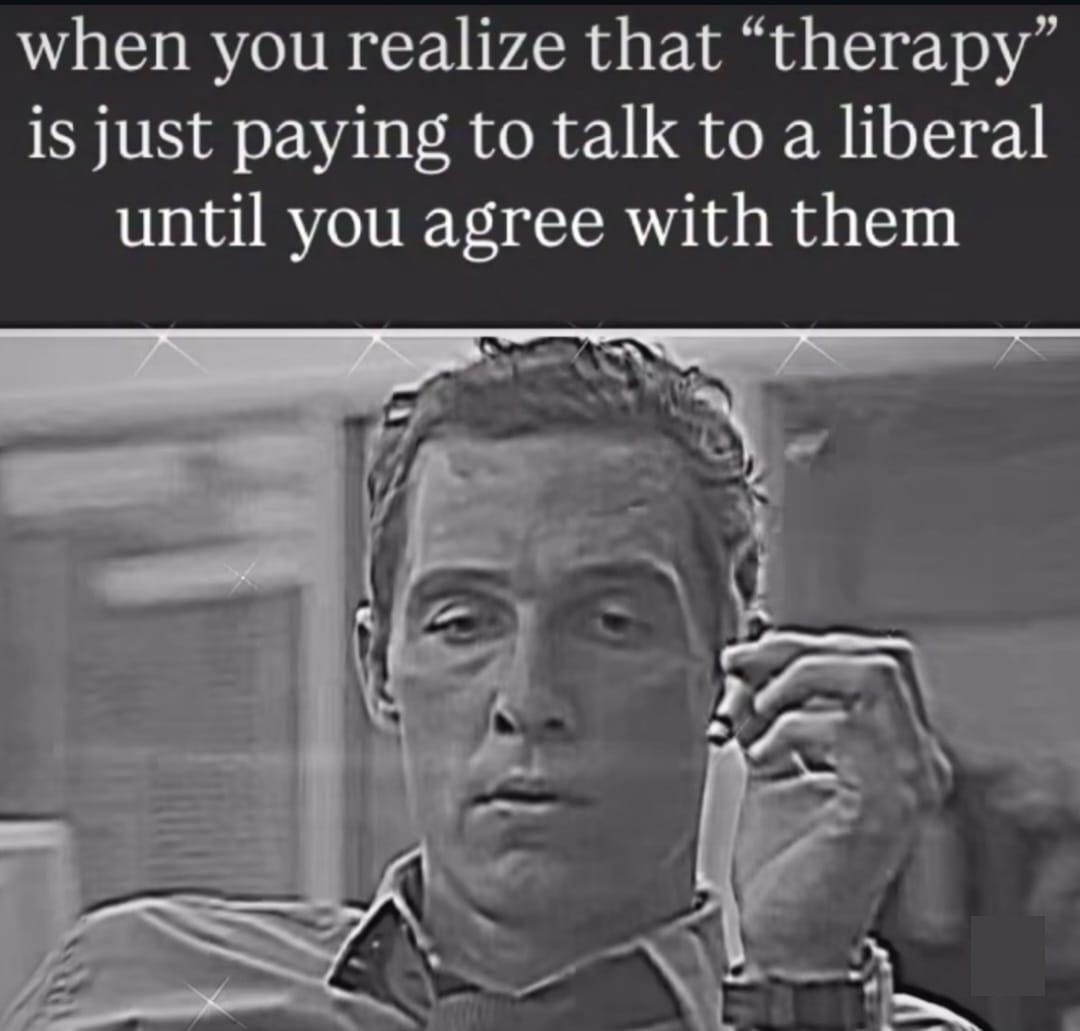
So then what is the point of therapy? Well, apparently the point is to have a professional active listener repeatedly spit your own nonsense back at you until you realize how stupid you sound. I’m not sure why this requires licensure or a master’s degree, but the world is kind of dumb in general, so honestly I shouldn’t be that surprised.
“Most people go to therapy to pay for friends.”
The whole premise of therapy is built around a single mission: remove any practical tool that might actually help someone. A therapist is forbidden from correcting you or handing you the obvious missing puzzle piece that would fix your issue, because that would violate their sacred rule of never being useful. Instead, they follow the contrived protocol they were indoctrinated with in grad school for how to look thoughtful while contributing nothing. They watch you flail while repeating your own words back to you in slightly slower monotone until you hear how retarded the whole thing sounds. Therapists love nothing more than watching you emotionally strip down while they take notes like bored voyeurs. Competence is treated as a boundary violation, and clarity is considered dangerous. A functional client would not need them, so the system is designed to keep you dependent and infantilized.
In an effort to further this uselessness, therapy has invented its own dictionary to immortalize its scam. Instead of acknowledging that nothing is changing in your life, you can now call that “processing.” Being stuck is now a positive place to be in called “integrating.” Refusing to make decisions has been transformed from indecisiveness into “sitting with discomfort.” Therapy has essentially taken emotional spiraling and rebranded it as personal development. It has also turned trauma into a kind of social currency, where the more of a victim you act, the more your therapist nods approvingly, contrary to how real life actually is. The more whiny noise you make, the more “insight” you supposedly have. They even teach you how to become fluent in this psychobabble, as if learning fancier words for stagnation will magically turn it into growth. It has transformed negatives into positives and given careers to otherwise unintelligent people who provide nothing to society except a thesaurus for dysfunction.
Action is the enemy of therapy, whilst feelings are the most valuable currency (except for the money you’re paying to your therapist, obviously). Action means your life is improving and changing for the better, which is considered a betrayal of the entire therapeutic model. Rather than encouraging decisive movement, therapists generally discourage it, supplanting it with a feelings-coded experience where the intangible is paramount and reality is an afterthought. Any sign of resilience or strength is brushed aside, while emotional fragility is celebrated as “vulnerability,” the holy sacrament of the profession. Rather than simply stalling adulthood, it reverses it, and encourages emotional infantilization. Therapy replaces the real world with fantastical delusions that hold no weight in actual life, where you do not get rewarded for narrating your emotions; you get rewarded for doing something about them.
Therapy would be merely an embarrassing hobby for bored millennials if it were simply ineffective, but the real damage is that it encourages a worldview where your emotions outrank your actions, your impulses outrank your responsibilities, and your momentary discomfort governs your entire life. It trains you to see fragility as wisdom, overthinking as insight, and avoidance as some kind of deep spiritual practice. This would be hilarious were it not the dominant religion of our generation, convincing millions that their feelings are more real than actual reality. The cultural fallout is literally everywhere you look: adults who cannot cope, cannot work, cannot decide, cannot commit, and cannot move. Therapy hasn’t just failed to help people grow, it has produced a society of psychologically domesticated losers incapable of living their own lives without their taxpayer-subsidized weekly worship service at The Church of Learned Helplessness.
To my readers: do not fall for this scam. Therapy, like bon bons, may make you feel better in the moment, but both are actively damaging to you. Making positive changes in your life, such as regular gym attendance or growing your business, will make you feel not so good in the short term but will grant you long-term happiness and success. Engaging with a pathology that psychs you out of action and focuses endlessly on the intangible will lead you straight into a pit of nothingness and sadness. Whenever you are tempted to “process,” understand that you are being sold a feeling instead of a result. Real growth feels painful and uncomfortable because it is actual change. Therapy simply numbs the discomfort while preserving the dysfunction. If you want a better life, you will get it from action, discipline, and forward movement, not from whatever this 21st century emotional junk is pretending to be. The world rewards people who do, not people who sit in circles talking about why they have not yet.